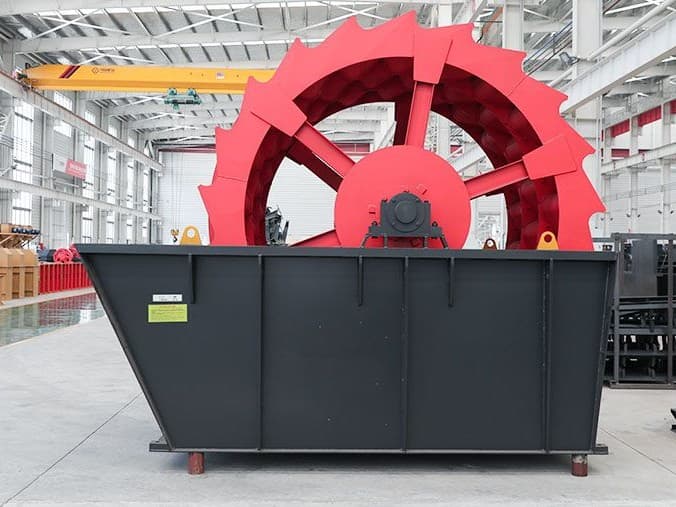
How Does a VSI Crusher Work? Sand Making and Shaping
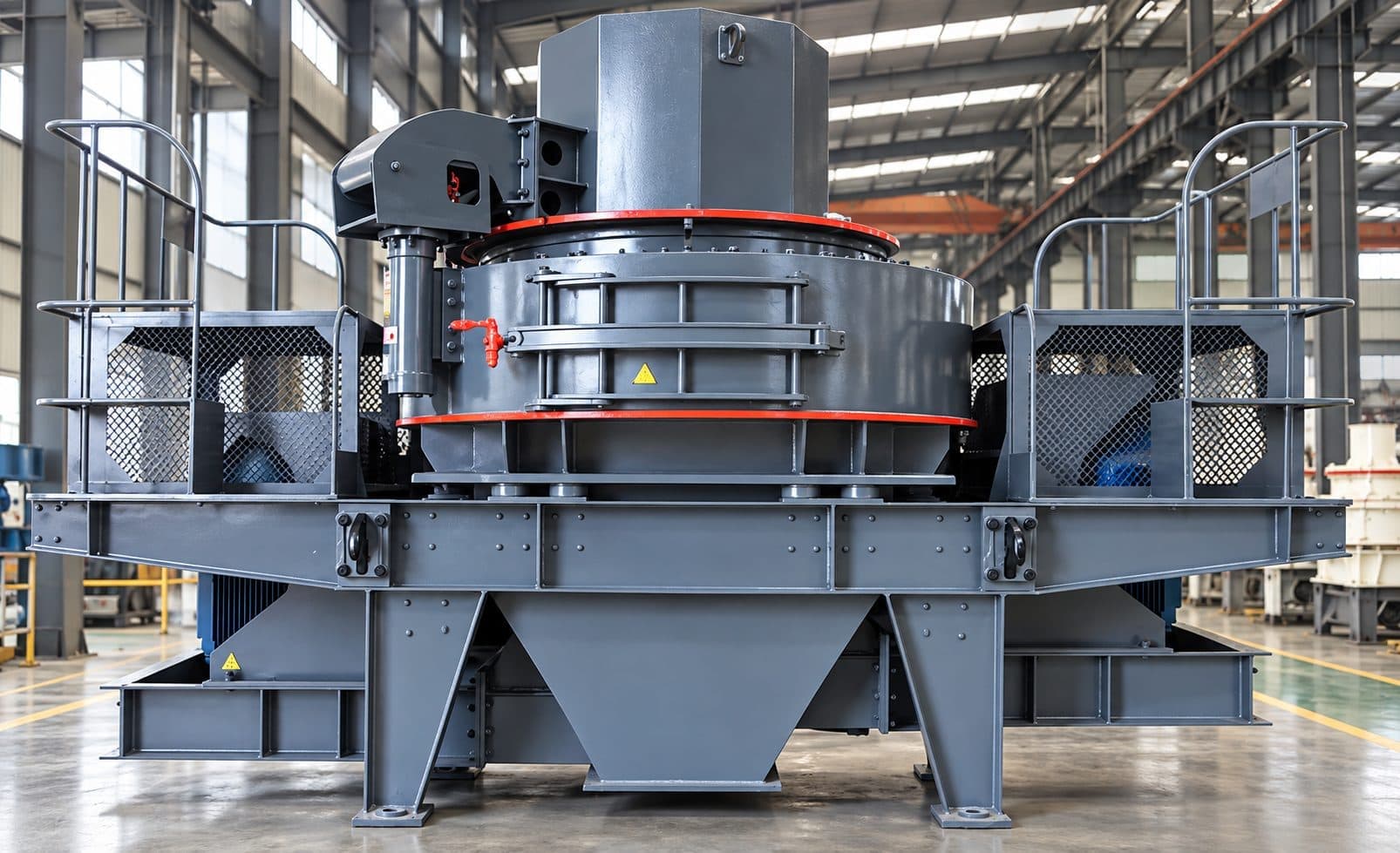
A cone crusher can produce the required aggregate size, yet some particles may still be flat or elongated. A sand plant may also need to turn smaller stone into a usable fine fraction. These are two reasons to add a vertical shaft impact crusher, or VSI, near the end of a crushing line.
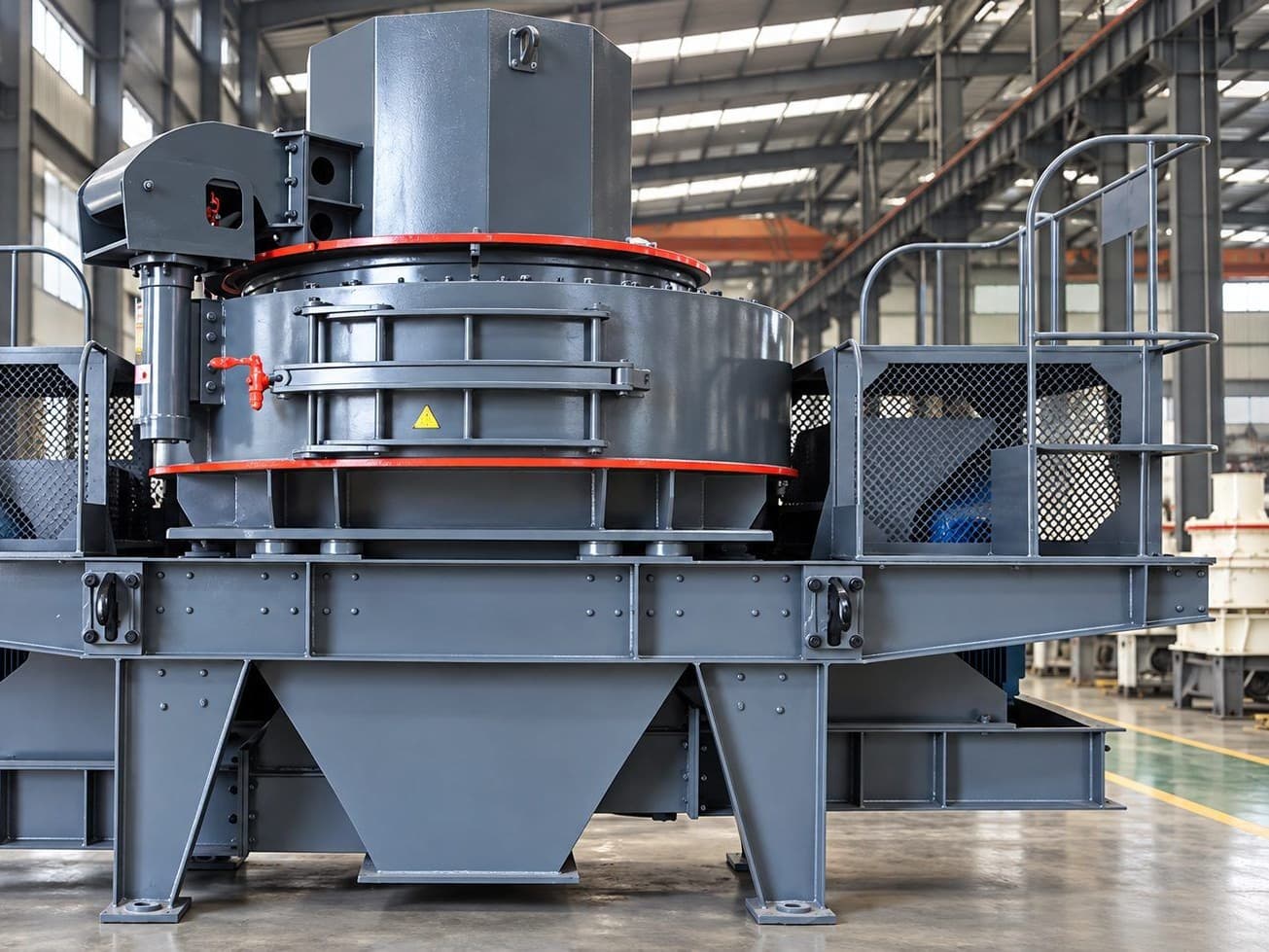
The Tanker VSI5X accelerates prepared stone through a fast-spinning rotor. When the particles meet the surrounding material bed or impact elements, their motion becomes the energy that breaks and reshapes them. The result is then screened to separate usable products from material that needs another pass.
Inside the machine: where the energy goes
The feed hopper guides stone into a distribution device. Material entering the centre of the rotor moves outward and gains speed before leaving through its discharge ports. The rotor is carried by a vertical shaft and bearing assembly; the drive supplies the energy, while wear parts protect the surfaces exposed to moving stone.
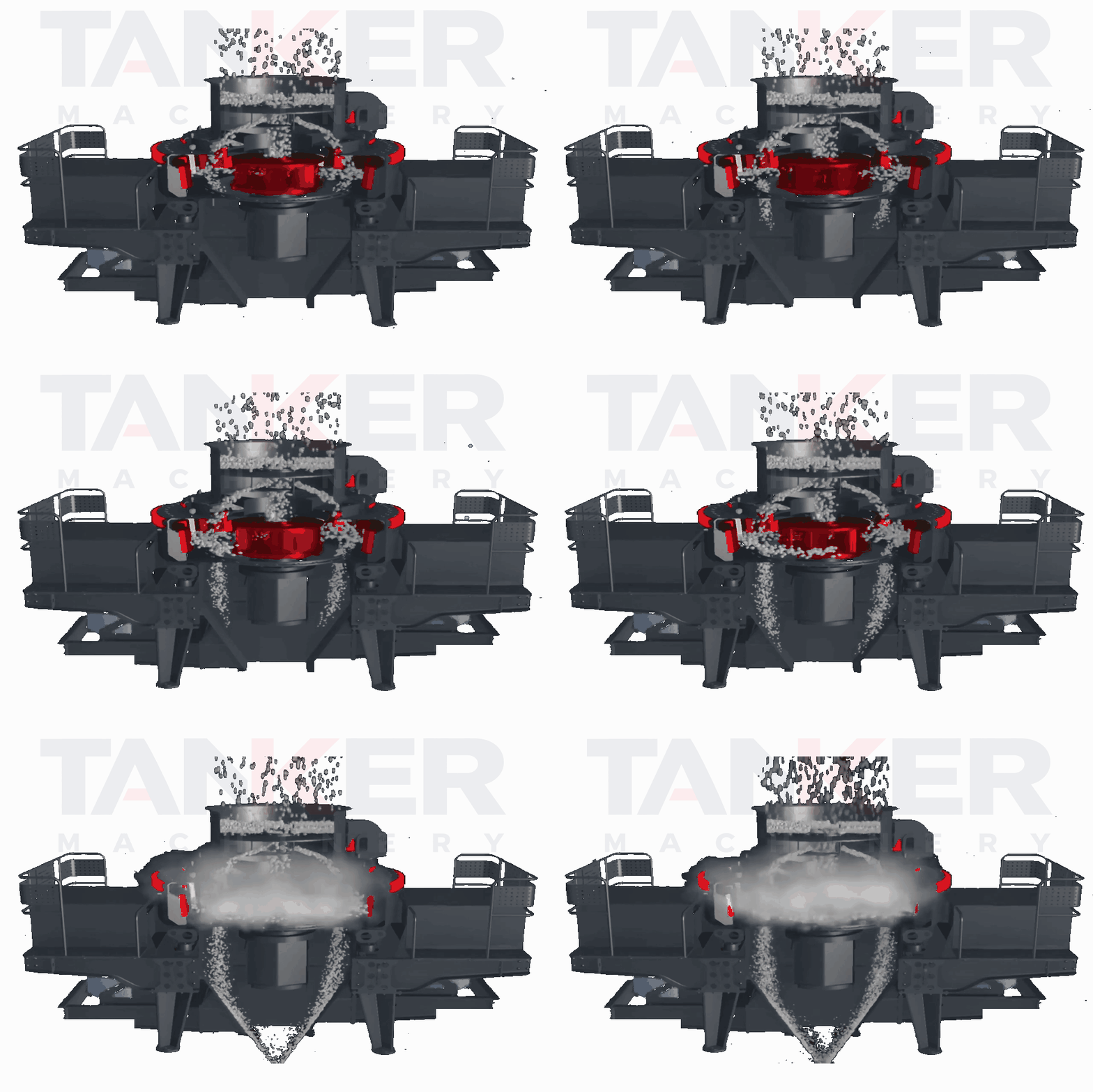
Tanker’s product animation illustrates the internal flow. The actual feeding arrangement and chamber configuration depend on the selected machine.
Think of the rotor as an accelerator. The main crushing action takes place when the accelerated stone meets resistance outside it. Rotor tips, the feed tube, distributor and chamber protection all influence where material travels, so their condition matters as much as the selected speed.
From prepared feed to finished fractions
Prepare the feed. Upstream crushing and screening bring the material within the selected model’s size limit. Large quarry rock does not go directly into the VSI5X.
Control the flow. A steady feed keeps the rotor load more consistent. In combined feeding, the distributor divides the stream between the rotor and the surrounding chamber.
Accelerate and impact. The rotor launches particles into the chamber. Collisions cause breakage; subsequent contact and rubbing can improve particle shape.
Discharge and screen. Material falls through the lower outlet. A screen separates saleable fractions and returns oversize for further processing where a closed circuit is used.
Two different choices: impact surface and feed route
These terms describe different parts of the process. Rock-on-rock or rock-on-metal describes what the accelerated material hits. Central or cascade feeding describes how the material reaches the chamber. One choice does not automatically determine the other.
Rock-on-rock and rock-on-metal
In a rock-on-rock arrangement, a retained material bed provides the main impact surface. It is often useful when shape improvement and limiting metal wear are priorities, especially with abrasive feed. Wear still occurs at rotor tips, feed components and other exposed parts.
With metal impact elements, particles strike replaceable metal surfaces. This can favour stronger direct reduction in a suitable application, but abrasive rock can raise wear costs. Chamber selection should follow the material and product target; do not assume every VSI5X order includes both arrangements or that a conversion requires no parts.
Central feed and central-plus-cascade feed
With central feed, the material stream passes through the rotor. With combined feed, one portion enters the rotor and another falls around it; the accelerated stream interacts with this surrounding curtain. The second route increases total material passing through the machine without requiring every particle to pass through the rotor.
That explains why the combined-feed capacity is higher in the model table. It does not promise the same reduction, sand yield or grading at the higher tonnage. The feed split must be selected together with the speed, feed grading and screen arrangement.
Tanker VSI5X model data
Model | Central feed (t/h) | Central + cascade (t/h) | Max. feed, soft / hard (mm) | Shaft speed (r/min) | Motor power (kW) |
|---|---|---|---|---|---|
VSI5X7615 | 70–140 | 150–280 | <35 / <30 | 1700–1900 | 2×75 |
VSI5X8522 | 120–190 | 240–380 | <40 / <35 | 1500–1700 | 2×110 |
VSI5X9532 | 180–280 | 350–540 | <45 / <40 | 1300–1510 | 2×160 |
VSI5X1145 | 250–360 | 500–640 | <50 / <45 | 1100–1310 | 2×220 |
Nominal model data; capacities are total machine throughput. Maximum feed limits depend on material hardness. Final settings and configuration are confirmed for the project.
The speed ranges are model-specific. A smaller rotor and a larger rotor can have different shaft speeds while serving the same process role. Operators should use the permitted range for their machine rather than copy another model’s rpm.
Why 300 t/h through the machine is not 300 t/h of sand
Crusher throughput counts all material passing through it, including recirculated oversize. Finished-sand output counts only the fraction that meets the agreed product specification after screening and any required classification or washing.
For example, if 200 t/h of fresh material and 100 t/h of returned oversize enter the VSI, its load is 300 t/h. At a stable mass balance, the line still receives only 200 t/h of new material, and only part of that may become the target sand fraction. This is an illustration, not a performance prediction.
A production estimate therefore needs the feed grading, desired fractions and expected circulating load. Our vibrating-screen guide explains the separation stage.
What changes the result?
Feed size and consistency: occasional oversize or large feed surges disturb an otherwise stable process.
Rotor speed: more speed generally means more impact energy, but can also mean more fines, power demand and wear. Stay within the approved range.
Rock characteristics: hardness, abrasiveness and natural fracture behaviour affect reduction, shape and wear differently.
Moisture and clay: sticky material can accumulate in the feed path and discharge. There is no single moisture limit suitable for every rock.
Screen performance: ineffective separation can increase return load or allow unwanted coarse particles into a finished fraction.
Keep performance stable as parts wear
Track motor load, vibration, bearing temperature and product grading. A change in one reading is a reason to investigate, not a reason to immediately increase speed. Check feed conditions and the screen as well as the crusher.
During planned, isolated shutdowns, inspect the feed tube, distributor, rotor tips and wear plates, chamber protection and discharge path. Replace rotor parts according to the machine manual to preserve balance. Internal inspection requires isolation, control of stored energy and confirmation that the rotor has stopped completely.
Choosing a VSI5X for your line
Start with the product you need: additional sand, better-shaped coarse aggregate, or a balance of both. Send Tanker a representative feed grading, material description, moisture and clay information, target fractions and hourly output, plus details of the existing crushers and screens. Contact Tanker to review the model, feeding method and screening circuit together.
Frequently asked questions
Can a VSI5X replace the primary jaw crusher?
No. Its feed limits are much smaller. Primary and, where needed, secondary crushing prepare the material before it reaches the VSI.
Is a VSI only for making sand?
No. It can also reshape coarse aggregate. The selected setup should reflect whether the priority is reduction, particle shape or both.
Does cascade feeding always make more sand?
No. It can increase total throughput, but saleable sand output depends on the proportion reaching the target grading and on the screening circuit.
Does rock-on-rock mean there are no wear parts?
No. The material bed limits direct contact with some metal surfaces, but the rotor, feed system and other exposed components still need maintenance.
Can the VSI guarantee a finished 0–5 mm product by itself?
No. A crusher discharge contains a size distribution. Screening establishes the product cut, while fines control or washing may also be needed to meet the finished-sand specification.