HPT Cone Crusher Parts: 22 Components and Their Functions
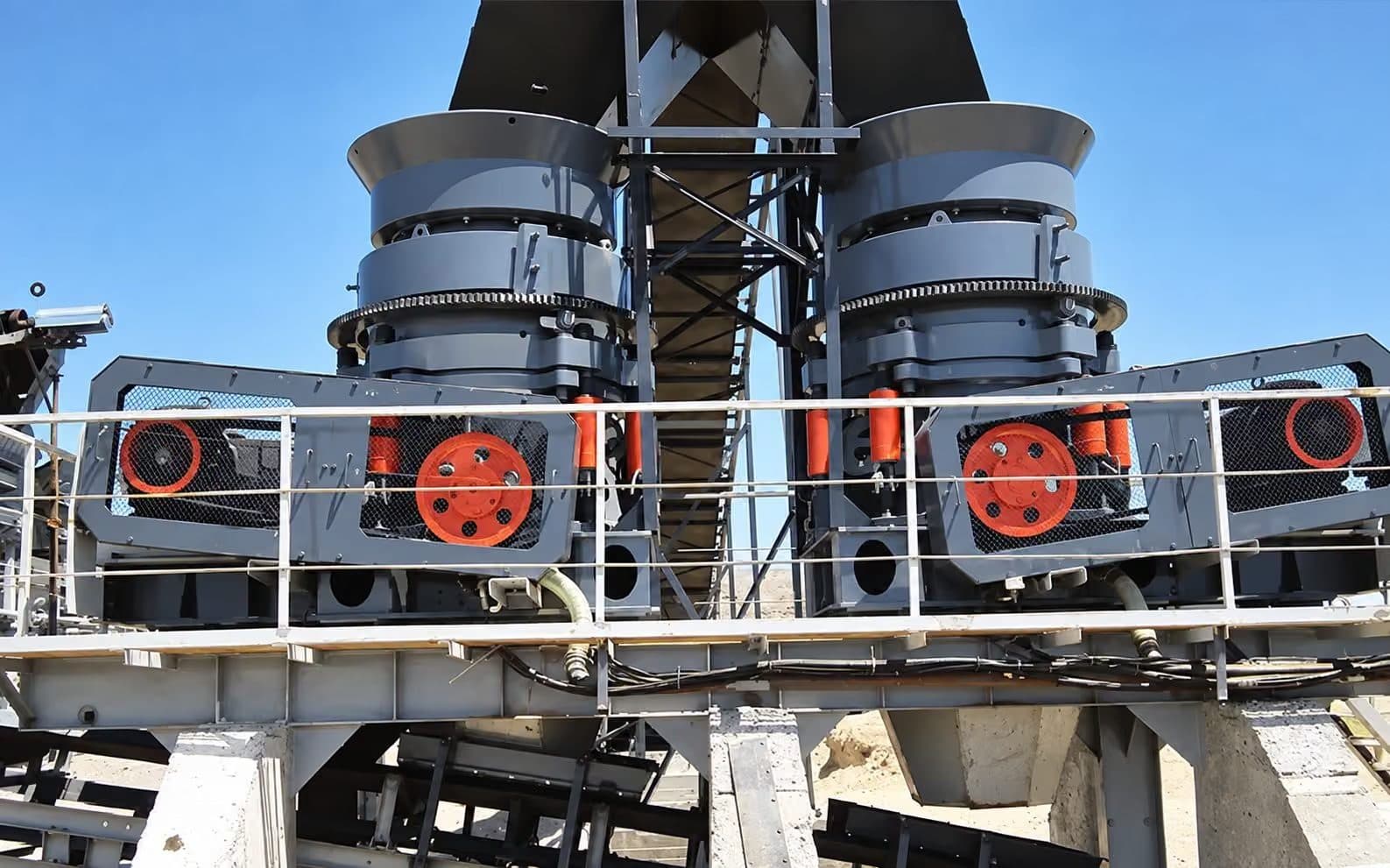
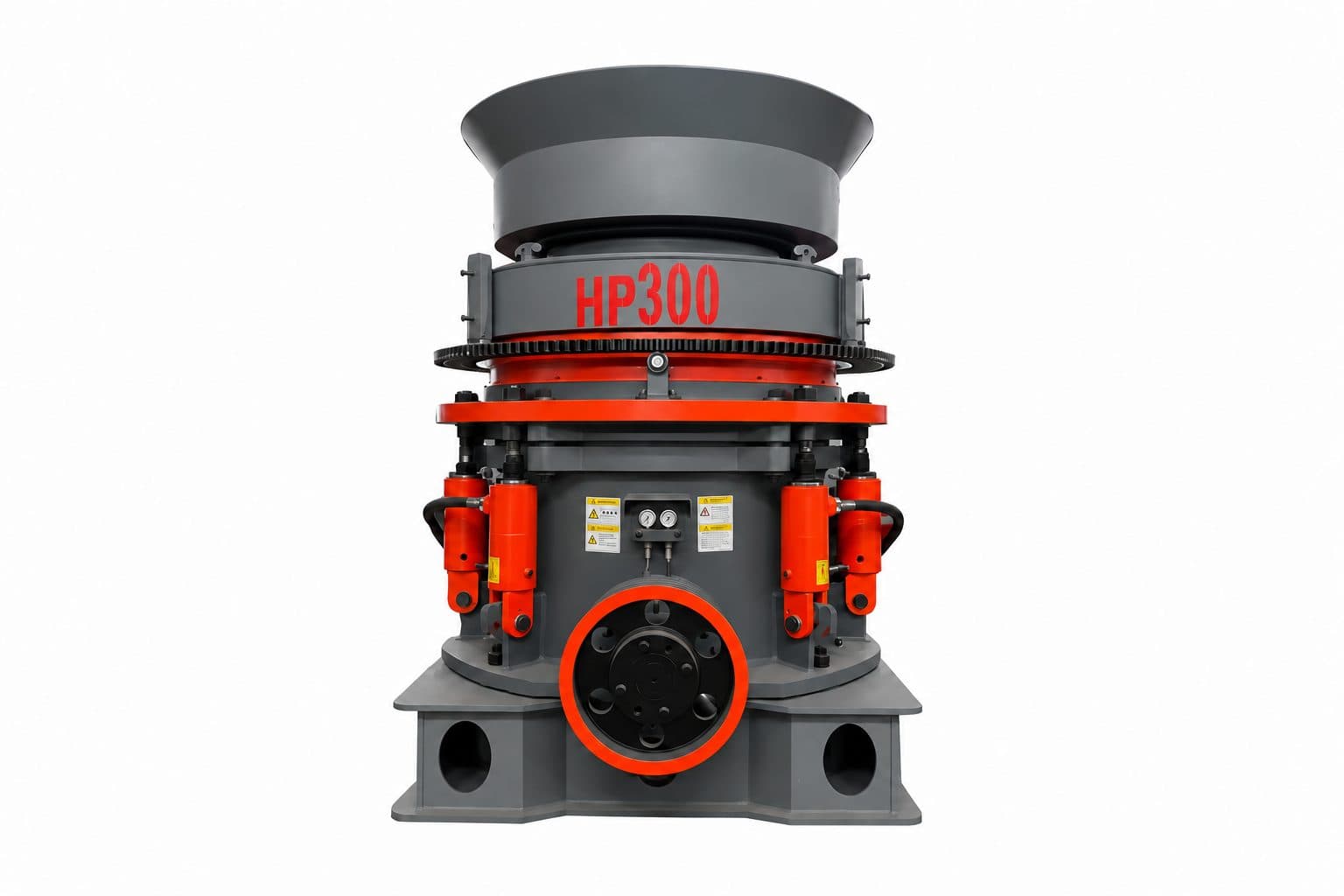
Using the wrong name for a cone crusher component can result in an incorrect spare part, a longer shutdown or the wrong liner profile. This guide follows the construction of Tanker’s HPT Series Multi-Cylinder Hydraulic Cone Crusher and the manufacturer’s numbered cutaway, so the terminology stays consistent from the machine page to a parts enquiry.
In short: the motor transfers rotation through the pulley, countershaft and bevel-gear pair to the eccentric bushing. The eccentric produces the controlled gyrating movement of the moving cone, while rock is compressed between the stationary concave and moving mantle. Hydraulic cylinders adjust and lock the upper assembly and protect the chamber when uncrushable material enters.
Scope note: these labels describe the illustrated HPT arrangement. Names and construction can differ by manufacturer, model and revision. Always verify the complete model, serial number and drawing reference before ordering.
How do the HPT components work together?
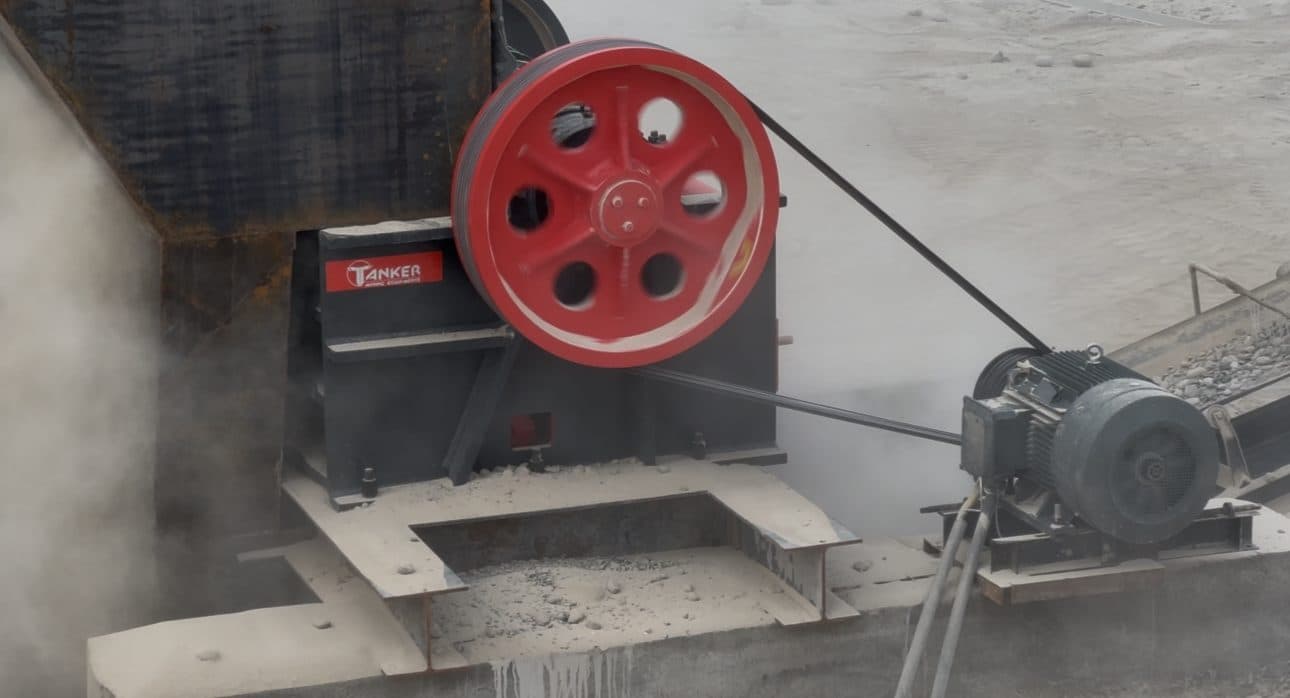
The motor drives the pulley and horizontal countershaft through a belt transmission.
The drive pinion turns the larger driven bevel gear and eccentric bushing. This gives the moving cone its controlled gyrating motion around the main shaft.
Feed enters from above, is compressed repeatedly between the two liners, and travels downward toward the discharge opening as its size is reduced.
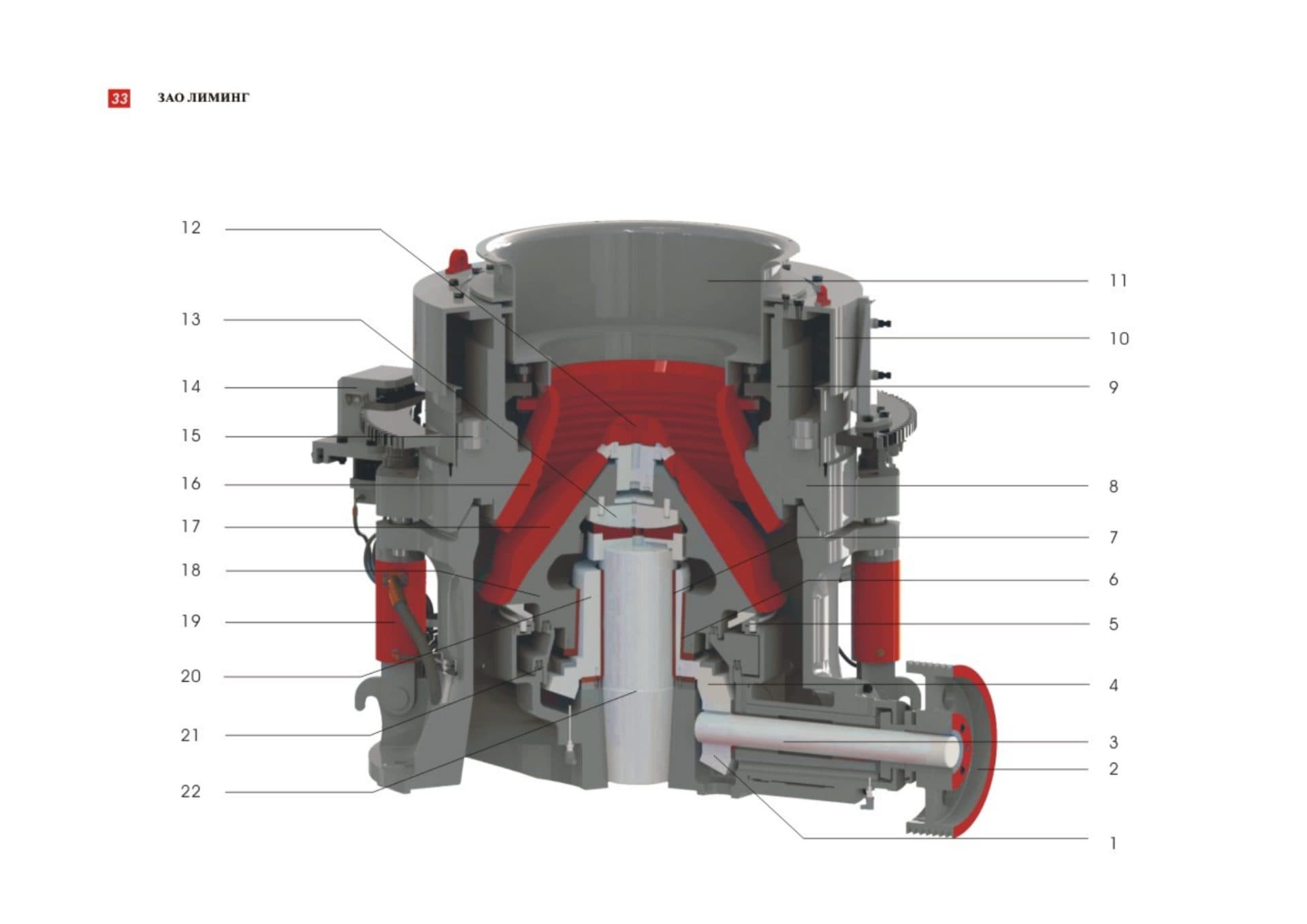
Factory cutaway of the HPT crusher. The numbers below correspond directly to the callouts in the diagram.
HPT cone crusher parts list: 22 components
No. | Component | Primary function |
|---|---|---|
1 | Drive bevel pinion | Transfers torque from the countershaft to the larger bevel gear. |
2 | Pulley | Receives motor power through the belt drive and turns the countershaft. |
3 | Countershaft / drive shaft | Connects the pulley to the drive pinion and carries rotation into the crusher body. |
4 | Driven bevel gear | Receives torque from the pinion and rotates the eccentric assembly. |
5 | Spherical floating dust seal | Restricts stone dust and fine particles from entering the lubricated area. |
6 | Lower cylindrical bushing | Guides the rotating assembly and transfers radial load to its supporting surfaces. |
7 | Eccentric inner bushing | Forms the sliding bearing surface between the eccentric and shaft. |
8 | Support sleeve | Supports the upper adjustment assembly and transfers load to the frame. |
9 | Adjustment ring | Participates in positioning the upper assembly and setting the discharge opening. |
10 | Dust cover | Shields the upper mechanisms from stone dust and spilled feed. |
11 | Feed hopper | Receives material and directs it into the crushing chamber. |
12 | Cone head | Provides the mounting body for the mantle and transfers crushing force into the cone assembly. |
13 | Spherical bearing / socket liner | Supports the cone head while accommodating its gyrating movement. |
14 | Hydraulic adjustment unit | Drives the adjustment mechanism and helps change the discharge setting. |
15 | Locking cylinder | Holds the adjusted upper assembly securely in its operating position. |
16 | Concave (stationary liner) | Forms the replaceable outer wear surface of the crushing chamber. |
17 | Mantle (moving liner) | Applies compressive force to the feed and forms the chamber’s replaceable inner wear surface. |
18 | Moving cone | Carries the mantle and converts eccentric motion into crushing action. |
19 | Tramp-release / safety cylinder | Relieves overload and helps open the chamber when uncrushable material enters. |
20 | Eccentric bushing | Converts rotational input into the gyrating motion of the moving cone. |
21 | U-type seal | Retains lubricant and restricts contamination from reaching the bushing area. |
22 | Main shaft | Centers the moving assembly and carries the principal crushing loads. |
Which components are wear parts?
The most frequently replaced components are the concave, No. 16, and the mantle, No. 17. They contact the feed directly. Their profiles influence chamber type, maximum feed size, closed-side setting (CSS) and product gradation, so a liner should not be selected from appearance or outside diameter alone.
Bushings, seals, the spherical bearing and gears also wear, but their service life depends heavily on lubrication, load, contamination control and alignment. When one of these parts is inspected, its mating surface should be checked at the same time.
What should be checked during maintenance?
Mantle and concave: uneven profile, cracking, looseness and remaining thickness relative to the manufacturer’s service limit.
Gears: tooth-contact pattern, scoring, pitting, unusual noise and metallic debris in the oil.
Bushings and main shaft: excess clearance, overheating, scoring and changes in oil pressure or temperature.
Seals: dust ingress, oil leakage and damage to flexible sealing elements.
Hydraulics: pressure loss, leakage, uneven cylinder movement and a setting that changes without command.
A blanket rule such as “replace at 50% wear” is not reliable for every chamber and material. Use the limits in the manual for the exact model, the manufacturer’s permitted dimensions and the site’s measured wear history together.
How can uneven liner wear be reduced?
Feed the chamber centrally and distribute material evenly around it. Segregated or one-sided feeding produces biased wear.
Maintain stable choke feeding and keep the largest feed within the model’s stated limit.
Measure the CSS regularly instead of judging the setting only from the finished product.
Record lubricant level, cleanliness, pressure and temperature.
Keep metal detection and other protection against uncrushable objects operational.
What information is needed to order a spare part?
“We need a mantle for an HPT” is usually not enough. For reliable identification, provide:
the complete crusher model and machine serial number;
the part number or its position on an available drawing or catalogue;
the chamber type and liner profile;
key dimensions and clear photographs of the installed part;
the processed material, maximum feed size, CSS and required product fraction;
the quantity and planned replacement date.
With this information, Tanker’s specialists can check compatibility, review the wear pattern and identify the required parts set without guesswork.
Frequently asked questions
What are the main wear parts in an HPT cone crusher?
The main wear pair is the concave (stationary liner, No. 16) and mantle (moving liner, No. 17). Together they form the crushing chamber and contact the feed.
Are the mantle and moving cone the same component?
No. The mantle is a replaceable wear liner. The moving cone is the structural assembly that supports it. They are Nos. 17 and 18 in the diagram.
Are the concave and adjustment ring the same part?
No. The concave is the stationary wear liner that contacts the feed. The adjustment ring belongs to the upper support and setting mechanism. Their functions and part numbers are different.
What causes uneven liner wear?
Common causes include off-centre or segregated feeding, insufficient chamber fill, oversize feed, an unsuitable CSS and unstable distribution around the chamber.
When should cone crusher liners be replaced?
Replace them when remaining thickness reaches the manufacturer’s service limit, the worn profile can no longer hold the required product, cracking develops or secure retention is compromised. Base the decision on the model manual and actual measurements.
Is the crusher model enough to select an HPT spare part?
Usually not. The same model can use different chambers and liner profiles. A serial number, drawing or part number, dimensions and photographs greatly reduce the risk of supplying an incompatible part.